⚖️ Free BMI Calculator - Calculate Your Body Mass Index Instantly
Calculate your Body Mass Index instantly – Check if you're underweight, normal, overweight, or obese
⚖️ BMI Calculator: Best Free Tool for Body Mass Index 2026
📅 Updated: October 7, 2026 | 👁️ 16 min read | ✍️ By Zain Uddin
⚖️ What is a BMI Calculator? A BMI calculator is a free online tool that calculates your Body Mass Index using your height and weight. It helps adults understand whether their BMI falls into the underweight, healthy weight, overweight, or obesity category. This tool uses the standard formula: weight in kilograms divided by height in meters squared. Enter your measurements to get an instant result without registration. BMI is a general screening measure, not a medical diagnosis. It does not directly measure body fat or determine a person's overall health.
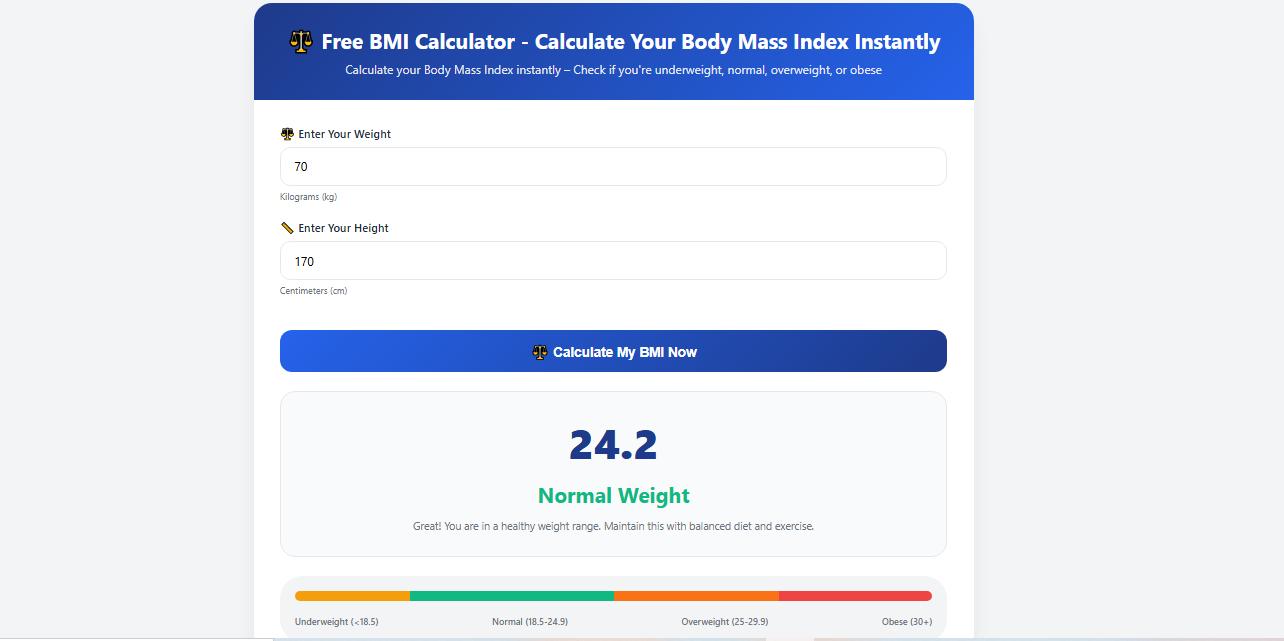
Screenshot: BMI Calculator displaying a sample BMI result and weight category.
📚 Table of Contents
⚖️ 1. What is a BMI Calculator?
A BMI calculator (Body Mass Index calculator) is a tool that estimates a person's weight category using their height and weight. It calculates a numerical value using the standard formula: BMI = weight (kg) ÷ height (m)². This value can help adults understand whether their weight falls within the underweight, healthy weight, overweight, or obesity range.
BMI is commonly used as a screening measure by healthcare professionals and individuals. However, it does not directly measure body fat, muscle mass, or overall health. A high or low BMI may indicate a reason to discuss health and weight with a qualified healthcare professional, but it cannot diagnose a medical condition on its own.
📌 Did You Know? The BMI concept was developed by Belgian mathematician and statistician Adolphe Quetelet in the 19th century. It is now widely used as a simple screening measure to assess weight categories.
📐 2. How to Calculate BMI
Body Mass Index (BMI) is calculated by dividing a person's weight by the square of their height. You can use either the metric system (kilograms and meters) or the imperial system (pounds and inches).
📌 Metric System (kg, meters)
BMI = Weight (kg) ÷ Height (m)²
Example: 70 kg ÷ (1.75 m × 1.75 m) = 22.86
📌 Imperial System (lbs, inches)
BMI = (Weight in lbs ÷ Height in inches²) × 703
Example: (154 lbs ÷ (69 in × 69 in)) × 703 = 22.7
You can calculate BMI manually using these formulas or use our free online BMI calculator to get your result instantly. Simply enter your height and weight, select the appropriate measurement units, and calculate your BMI.
📊 3. BMI Categories and Ranges
For adults aged 20 and older, BMI values are grouped into standard categories. These ranges can help provide a general picture of weight status, but they should not be treated as a complete assessment of health.
Important: These BMI categories are intended for adults aged 20 and older. BMI does not directly measure body fat or diagnose a health condition. Age, muscle mass, medical history, and other factors may affect how a BMI result should be interpreted. For children and teenagers, BMI is assessed using age- and sex-specific percentiles.
🛠️ 4. How to Use This BMI Calculator
Follow these simple steps to calculate your Body Mass Index using this online BMI calculator:
- Step 1: Enter your weight in kilograms (kg).
- Step 2: Enter your height in centimeters (cm).
- Step 3: Select the calculate option.
- Step 4: View your BMI result and corresponding weight category.
- Step 5: Read the result explanation to understand what your BMI value means.
💡 Helpful Tip: If you track your BMI over time, use measurements taken under similar conditions. Remember that BMI is a general screening measure, not a complete picture of your health. For adults, the standard healthy weight BMI range is 18.5 to 24.9.
✅ 5. Why Use a BMI Checker?
A BMI checker provides a quick way to calculate Body Mass Index using height and weight. It can help adults understand their general weight category and follow changes in their BMI over time.
- Instant Calculation: Calculate your BMI in seconds using your height and weight.
- Understand Your Weight Category: See whether your adult BMI falls into the underweight, healthy weight, overweight, or obesity category.
- Track Changes Over Time: Compare BMI results from different dates to observe changes in your weight status.
- Support Fitness Goals: Use your BMI result as one general reference when setting realistic fitness and weight-management goals.
- Simple and Convenient: Calculate BMI online without doing the formula manually.
- Free to Use: Access the calculator without registration.
📌 Remember: BMI is a screening measure, not a medical diagnosis. It does not directly measure body fat or account for every difference in body composition. Use it as one piece of information rather than a complete measure of your health.
💼 6. Real-Life Use Cases for BMI Calculator
Body Mass Index (BMI) is used in different settings as a simple screening measure based on height and weight. It can provide useful general information, but its meaning depends on a person's age, body composition, and overall health.
🏥 1. Medical and Healthcare Settings
Healthcare professionals may use BMI as one part of a routine health assessment. An adult's BMI category can help identify whether further discussion or assessment may be useful. However, BMI alone cannot diagnose conditions such as diabetes, heart disease, or high blood pressure.
🏋️ 2. Fitness and Weight Management
People may use BMI as a general reference when reviewing their weight-management goals. Fitness professionals can consider it alongside other information, such as strength, fitness level, body composition, and individual goals. BMI alone is not a measure of athletic performance or fitness.
🎯 3. Personal Weight Tracking
Individuals can calculate their BMI at home to understand their general adult weight category. Comparing results over time may show changes in weight status. For a more complete picture, BMI should be considered alongside other health information.
🏫 4. Child and Teen Health Screening
In some healthcare and school health programs, BMI may be used to screen children and teenagers. Their results must be interpreted using age- and sex-specific BMI percentiles rather than the standard adult BMI categories. A child's BMI result should be discussed with an appropriate healthcare professional when needed.
📊 5. Health Research and Population Studies
Researchers and public health organizations use BMI data to study weight patterns across large groups of people. It can help compare population-level trends over time, although BMI does not describe every individual's health or body composition.
💡 Important Reminder: BMI is a screening measure, not a diagnostic test. A healthcare professional can interpret your result alongside other relevant information to provide a more complete assessment.
👨👩👧👦 7. BMI for Different Groups
BMI results should be interpreted according to a person's age and individual circumstances. The standard adult BMI categories are not suitable for everyone. Here is how BMI is considered for different groups:
- Children and Teenagers: BMI is interpreted using age- and sex-specific percentiles because their bodies are still growing. Adult BMI categories should not be used for children.
- Adults: For adults aged 20 and older, standard BMI categories are commonly used. A BMI from 18.5 to 24.9 is classified as the healthy weight range.
- Older Adults: BMI should be considered alongside factors such as muscle loss, physical function, medical history, and nutritional status. There is no single higher BMI cutoff that is suitable for every older adult.
- Athletes and Muscular Individuals: People with higher muscle mass may have a higher BMI even when they have relatively low body fat. BMI does not distinguish muscle from fat.
- Pregnant Women: Standard adult BMI categories do not assess weight status during pregnancy. Healthcare professionals consider pre-pregnancy BMI and other pregnancy-related factors when monitoring weight.
- Different Ethnic Groups: Health risks associated with body weight can vary between populations. Some ethnic groups may experience certain weight-related health risks at lower BMI values, so individual interpretation may require additional guidance.
📌 Important: BMI is a general screening measure and does not provide a complete assessment of health. If you are calculating BMI for a child, are pregnant, or have specific health concerns, ask a qualified healthcare professional for appropriate interpretation.
📊 8. Specialized BMI Calculations and Related Measures
Standard BMI calculations are designed mainly for adults. Other age groups and health situations may require different assessment methods. Here are some related calculations and measurements worth understanding.
🐕 1. Dog Weight Assessment
Dogs are not assessed using the standard human BMI formula. Veterinarians commonly evaluate a dog's body condition by considering factors such as body shape, visible waistline, abdominal tuck, and how easily the ribs can be felt. Breed, age, and overall health are also important when assessing a dog's weight.
👶 2. Pediatric BMI Calculator
Children and teenagers need a different BMI assessment from adults. Pediatric BMI is interpreted using age- and sex-specific percentiles because body composition changes as children grow. For example, the CDC provides BMI-for-age growth charts and a pediatric BMI calculator for children and teens aged 2 to 19 in the United States.
⚕️ 3. BMI and Body Surface Area (BSA)
BMI and Body Surface Area (BSA) are two different measurements. BMI compares weight with height, while BSA estimates the total external surface area of the body. BSA is used in certain medical calculations, including some medication-dosing decisions. These measurements serve different purposes and should not be confused.
🏋️ 4. Body Composition and Muscle Mass
Standard BMI does not distinguish between muscle, fat, and bone mass. This means people with a high amount of muscle may have a higher BMI even if they have relatively little body fat. Other measurements, such as waist circumference and professional body composition assessments, may provide additional information when appropriate.
📌 Important: These specialized assessments are not features of every standard BMI calculator. Choose an assessment method appropriate to the person's age and circumstances, and consult a qualified healthcare professional when you need medical guidance.
📊 9. How to Calculate BMI in Excel
You can calculate Body Mass Index (BMI) in Microsoft Excel using a simple formula. Enter your weight and height into separate cells, then use the appropriate formula for your measurement system.
📌 Excel Formula for BMI (Metric System)
Suppose your weight in kilograms is entered in cell A2 and your height in meters is entered in cell B2.
=ROUND(A2/(B2*B2),1)
Example: A2 = 70 kg and B2 = 1.75 meters. The formula returns a BMI of 22.9.
📌 Excel Formula for BMI (Imperial System)
If your weight in pounds is entered in cell A2 and your height in inches is entered in cell B2, use this formula:
=ROUND((A2/(B2*B2))*703,1)
Example: A2 = 154 lbs and B2 = 69 inches. The formula returns a BMI of approximately 22.7.
📝 How to Use the Excel Formula
- Open a blank worksheet in Microsoft Excel.
- Enter your weight in cell A2.
- Enter your height in cell B2 using the correct unit.
- Enter the matching BMI formula in cell C2.
- Press Enter to display your calculated BMI.
💡 Tip: Make sure your height and weight units match the formula you are using. For the metric formula, enter height in meters, not centimeters. For the imperial formula, enter height in inches. These examples use positive, valid measurements.
❓ 10. Frequently Asked Questions (FAQ)
🎯 11. Conclusion - Calculate Your BMI Online
Body Mass Index (BMI) is a simple way to compare weight with height and understand a general weight category. Our free online BMI calculator makes this calculation easy by providing a result without requiring you to work through the formula manually.
Here are the main points to remember:
- Use the BMI formula to understand the relationship between your height and weight.
- For adults aged 20 and older, a BMI of 18.5 to 24.9 is generally classified as healthy weight.
- Children and teenagers need age- and sex-specific BMI percentile assessments.
- BMI does not directly measure body fat, muscle mass, or overall health.
- Consider BMI alongside other relevant health information rather than using it as a diagnosis.
Enter your height and weight in our Body Mass Index calculator to calculate your BMI and view your result. If you have questions about what your result means, a qualified healthcare professional can help interpret it based on your individual circumstances.
📌 Final Reminder: BMI is a useful starting point for understanding weight categories, but it is only one part of a broader picture of health. Focus on balanced habits and appropriate professional guidance rather than a single number.

About the Author: Zain Uddin
Founder, FreeOnlineTools203.com | Web Developer & SEO Expert
Zain Uddin is the founder of FreeOnlineTools203.com, a platform offering 240+ free online tools across 18 categories. With 3+ years of experience in web development, SEO, and freelancing (Fiverr), he personally builds and tests every tool for accuracy.